Glass guide
Glass guide: what to ask for, and why
What we explain on every visit, written down. Five minutes of reading to order the right glass and understand your quote line by line.
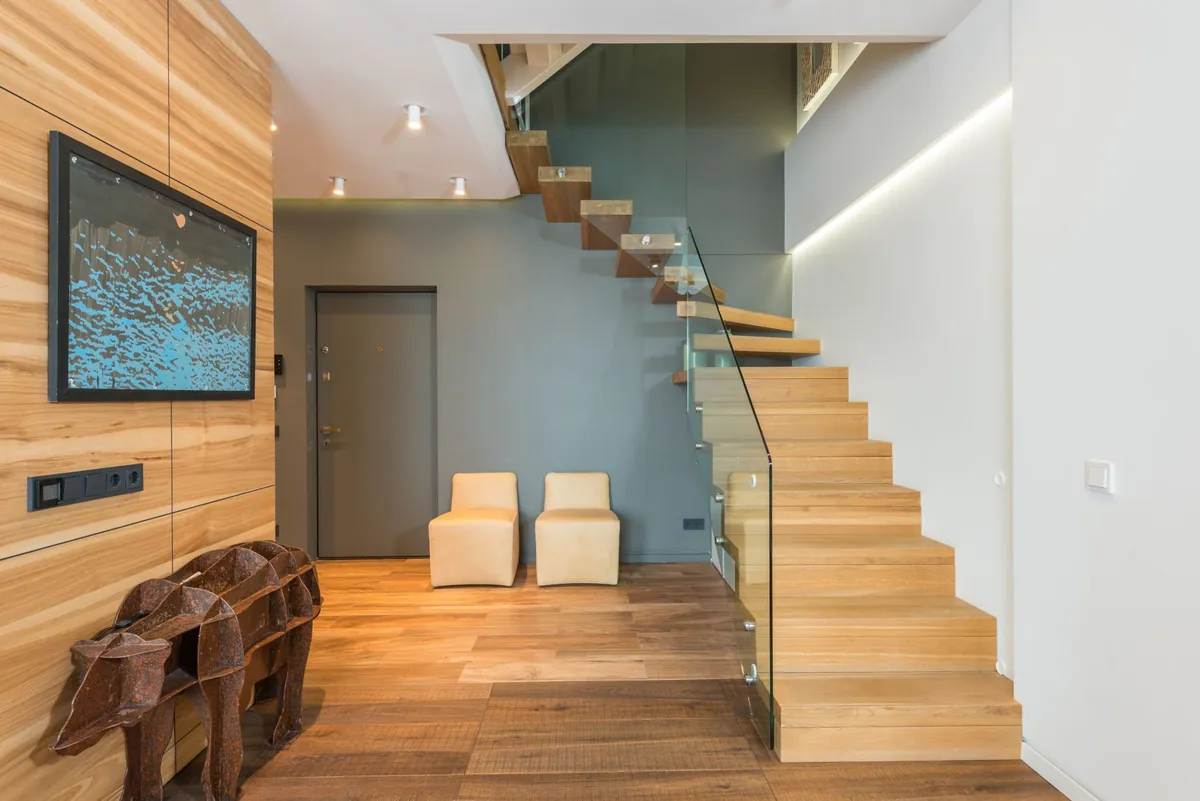
01 · Glass types
Toughened, laminated or float: which goes where
Float glass is the base product, the glass in an ordinary window. It breaks into large, sharp shards, so it is never used near people or under load: only in display cabinets, small shelves or behind a frame.
Toughened (tempered) glass goes through a furnace at around 650 °C and is cooled suddenly. It ends up about five times stronger than float of the same thickness and, if it breaks, it crumbles into small granules with no cutting edges. It is the glass for shower screens, doors, partitions and kitchen splashbacks. Important: once toughened it cannot be cut or drilled, which is why we measure before we make anything.
Laminated glass is two or more sheets bonded by a PVB or SentryGlas interlayer. If it breaks, the pieces stay stuck to the interlayer and the panel stays in place. That is why it is mandatory for balustrades, floors, canopies and any glass that protects against a fall. It can be combined: laminated from two toughened sheets (8+8, 10+10) is the norm for balustrades.
| Glass | How it breaks | Where we use it |
|---|---|---|
| Float | Large cutting shards | Cabinets, shelves, framed glass with no risk |
| Toughened | Small granules, no cutting edges | Shower screens, doors, partitions, splashbacks, glass curtains |
| Laminated | Cracks but does not fall | Balustrades, floors, stairs, canopies, balcony fronts |
| Toughened + laminated | The best of both | Balustrades without handrail, walk-on floors, structural glass |
02 · Thickness
What thickness each job needs
Thickness is not a case of “the more the better”: glass that is too thick is heavy, makes the fittings more expensive and adds nothing. These are the sizes we work with by default and why.
For balustrades the final thickness comes from calculation: it depends on height, the spacing between supports and whether there is a handrail. The figures in the table are the usual starting point; the final one goes in the quote.
| Job | Usual thickness | Why |
|---|---|---|
| Shower screen | 8 mm toughened (10 mm on large walk-ins) | Enough stiffness without loading the hinges |
| Mirror | 4–5 mm | Flat and light; 5 mm on large mirrors to avoid distortion |
| Kitchen splashback | 6 mm toughened, back-painted | Takes hob heat and allows cut-outs for sockets |
| Glass door | 10 mm toughened | Manageable weight at standard door sizes |
| Office partition | 10–12 mm toughened | Better acoustics and tall panels that do not vibrate |
| Glass curtain | 10 mm toughened | Sliding panels with no vertical frame |
| Balustrade | Laminated 8+8 or 10+10 | Fall protection; 10+10 without handrail or on long spans |
| Floor or tread | 3-ply laminated, from 10+10+10 | Specific calculation by span and load |
03 · Finishes
Clear, low-iron, frosted, smoked or back-painted
Standard glass has a slight green tint that shows on the edge and on large panels against white backgrounds. Low-iron (extra-clear) glass removes that tint: it is what we recommend for walk-in screens, exposed balustrades and anywhere the glass is the star.
Acid-etched frosting is a treatment of the glass itself, not a film: it does not scratch off or peel, and gives privacy while letting light through. It can cover the whole panel or just a band. Smoked glass (grey or bronze) softens the light and suits black brassware. Back-painted glass is toughened glass painted on the rear in any RAL colour: the finish for kitchen splashbacks.
Screen-printing or manifestation film allow patterns, logos or safety bands: mandatory on large partitions so nobody walks into the glass.
04 · Safety
What the regulations require
Spain's building code (CTE DB-SUA 1) sets the rules for protective barriers: a minimum height of 90 cm where the drop is up to 6 metres and 110 cm where it is more. Glass acting as a balustrade must be laminated safety glass and withstand the horizontal load set out in DB-SE-AE.
Toughened glass is made to EN 12150; laminated glass to EN 14449. Both carry CE marking, and their impact behaviour is classified with the pendulum test of EN 12600: class 1(B)1 or 1(C)1 is what we specify for balustrades and shower screens.
Shower screens have their own standard, EN 14428, covering glass, fittings and water-tightness. All of this goes in the quote as a reference, so you know what is being installed in your home.
| Situation | Minimum required | What we install |
|---|---|---|
| Balustrade, drop ≤ 6 m | 90 cm high, laminated glass | 100 cm, laminated 8+8 toughened |
| Balustrade, drop > 6 m | 110 cm high, laminated glass | 110 cm, laminated 10+10 toughened |
| Shower screen | Safety glass (EN 14428) | Toughened 8 or 10 mm, CE marked |
| Partition or glass door | Safety glass + visible manifestation | Toughened 10–12 mm with band or film |
05 · Fittings
Fittings and framing: 304, 316 stainless and aluminium
Less than a kilometre from the sea, the fittings matter as much as the glass. AISI 304 stainless steel is the indoor standard; on terraces, balconies and pools along the coast we install AISI 316, with molybdenum, which resists salt air without pitting.
For shower screens and mirrors the finishes are chrome, matt black, brushed gold and brushed steel, in solid brass or stainless. Aluminium profiles are powder-coated with a colour guarantee: they do not yellow or flake, which cheap anodised aluminium does after a few summers.
| Material | Where | Why |
|---|---|---|
| AISI 304 stainless | Indoors: stairs, screens, partitions | Good resistance, even finish |
| AISI 316 stainless | Outdoors by the sea, pools | Resists chlorides and salt |
| Solid brass | Shower hinges and handles | Precise closing, chrome/black/gold finishes |
| Powder-coated aluminium | Screen and enclosure profiles | Light, guaranteed colour, no corrosion |
06 · Treatments
Anti-limescale, anti-fog and solar control
Anti-limescale is a factory-applied hydrophobic treatment that seals the pores of the glass: water runs off in beads instead of drying on the surface and leaving scale. It is not permanent, but well looked after it lasts years and cuts cleaning to one pass with a squeegee. It is included on all our shower screens.
Mirror anti-fog is a very low-consumption heating film behind the glass, wired to the bathroom light: the mirror never steams up. And on terrace enclosures, double glazing with a low-emissivity coating turns the porch into a usable room in winter and avoids the greenhouse effect in summer.
FAQ
Frequently asked questions
What people ask us most before requesting a quote.
You may also need
Free quote within 24 h
Not sure which glass you need?
Send us a photo of the space on WhatsApp and we'll tell you which glass, thickness and fittings belong there. No obligation.
Free quote within 24 h
Let's talk about your project
We reply on WhatsApp in under an hour during working hours.
- Workshop and showroom
- Av. de Vidreres, 159-161, Bajos, Local 2
17310 Lloret de Mar (Girona)Get directions - Phone and WhatsApp
- 633 41 75 92
- Opening hours
- Monday to Friday: 10:00–12:00 and 17:00–19:00
Also by appointment outside these hours.
